
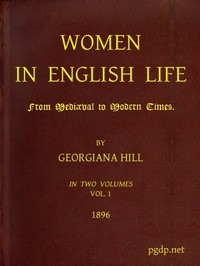
Women in English Life from Mediæval to Modern Times, Vol. I by Georgiana Hill
Published in 1896, Georgiana Hill's book is a groundbreaking piece of historical recovery. At a time when women's history was barely considered a subject, Hill set out to prove that women were not just passive background figures. She organizes her research not as a dry chronology, but by exploring the different roles women played across society.
The Story
There isn't a single plot, but there is a clear mission: to trace the visible footprint of women in England from the medieval period to Hill's own Victorian era (this first volume goes up to the 17th century). Hill acts as a guide, showing us women as rulers, like the formidable Queen Elizabeth I, but also as powerful abbesses who ran large estates. She then shifts focus to the middle classes and working women, uncovering evidence of women running breweries, working in skilled trades like silk-weaving, and operating businesses. She examines the legal frameworks—like the harsh laws of coverture that stripped married women of their property rights—and shows how women found ways to work within or around them. The "story" is the collective narrative of their agency, often hidden in plain sight.
Why You Should Read It
What makes this book so compelling is its perspective. Reading a late-Victorian woman writing about the struggles and achievements of her foremothers adds a powerful layer. You can feel Hill's own passion and sometimes her frustration. She doesn't just describe; she argues for recognition. The book is full of surprising details that challenge our assumptions—like the fact that many medieval guilds had female members, or that a woman's ability to run a business often depended more on local custom than national law. It makes history feel immediate and personal. You start to see the echoes of these past struggles in later movements for women's rights.
Final Verdict
This is a must-read for anyone curious about social history, women's history, or anyone who loves a good historical detective story. It's perfect for readers who enjoyed books like 'The Five' by Hallie Rubenhold or 'The Once and Future Sex' by Eleanor Janega, as it shares that mission of historical rediscovery. Be prepared for its 19th-century style—it's clear and engaging, but it is over a century old. That's part of its charm and its importance. It’s not the final word on the subject (modern scholarship has added much), but it is a foundational and fascinating starting point. You'll finish it looking at history with completely new eyes.
The copyright for this book has expired, making it public property. Knowledge should be free and accessible.





Kevin Martinez
11 months agoA bit long but worth it.