1

Tusayan katcinas — Text and Context
8
2
Project Gutenberg
2023
Hopi Indians -- Religion; Kachinas
Readers of public-domain and historical texts
Project Gutenberg digital edition
en
Edition facts
Words: 34,495
Reading time: 150 min
Text sections: 8
Source:
Project Gutenberg record #71003
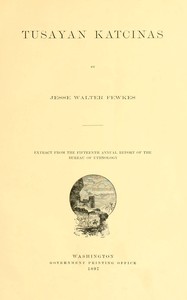
Jesse Walter Fewkes's 1897 ethnographic report classifies Hopi Katcina ceremonies into elaborate and abbreviated types, analyzing masks, altars, and seasonal sequences based on direct observation at Tusayan villages.
Editorial Edition Score
4.7/5
★★★★★
★★★★★
Calculated from edition completeness, EPUB availability, text structure and catalogue metadata. Not a user rating.
Edition quality
Fewkes opens by defining Katcina as a term applied both to supernatural beings impersonated by masked men and to the dances themselves, noting that ancestral worship is a significant component. He immediately confronts the complexity of the ritual system, advocating for long-term observation as the only adequate method for classification. The report is structured around a clear dichotomy: elaborate Katcinas with secret kiva ceremonials and abbreviated ones centered on public masked dances.
Elaborate vs. Abbreviated: A Structural Divide
Fewkes distinguishes two main groups of Katcina ceremonies based on the presence or absence of complex secret rites. Elaborate Katcinas, such as Soyáluña and Nimánkatcina, involve altars, kiva rituals, and a fixed set of essential personages—including Táwa (Sun), Mü′iyawû (Moon), and Pálülükoñti (Plumed Snake). Abbreviated Katcinas, by contrast, are simpler public dances where the mask symbolism alone determines the specific Katcina represented. The author stresses that any abbreviated Katcina may serve as the public component of the Nimán, but without the secret ceremonials it remains a different observance.
Recurring Imagery: Masks, Symbols, and Seasonal Cues
Throughout the excerpts, masks and their symbolic markings emerge as the primary identifiers of each Katcina. Fewkes describes how masks are repainted and redecorated for each ceremony, with designs referencing rain clouds, squash blossoms, stars, and the sun. The seasonal calendar is tied to specific celebrations: the return of the Katcinas, Powámû, and the Nimán or departure ceremony. Illustrations—such as plates of Natácka masks and dolls of Cálakomana—reinforce the visual vocabulary. The author notes that while stage effects may vary year to year, the deities represented remain consistent.
Movement Between Villages and Variation in Practice
Fewkes compares Katcina dances across Tusayan villages, observing that the same ceremony may differ materially from one year to the next. For instance, the 1891 Pálülükoñti included carved marionettes grinding corn and serpent effigies thrust through a screen, while the 1894 version used symbolic slabs and different figurines. The author attributes such latitude to permissible stage effects, not changes in essential personages. He also notes that only villages preserving the wími of the Kachina móñwi can host the Nimán celebration, whereas abbreviated Katcinas are not so limited.
The Role of Observation and Documentation
Fewkes explicitly frames his work as a data-gathering effort, recording details of individual observances as a basis for future generalization. He acknowledges gaps in his account—for example, stating that much remains to complete the description of the Nimán. The report is part of a larger series of publications, and the author frequently cross-references his own earlier articles. This self-referential method underscores the cumulative nature of ethnographic fieldwork, where each season’s observations refine and complicate earlier conclusions.
Fewkes’s report is best approached as a working document rather than a finished synthesis. Readers should attend to the interplay between the general classification and the specific variations he records across years and villages. The illustrations and plate descriptions are integral to understanding the mask symbolism he treats as diagnostic. Because the text is excerpted from a larger annual report, some ceremonial sequences may appear incomplete; the author’s own cautions about the need for extended observation are worth heeding.
Reader reflection
How did this book work for you?
Your answers remain private and are stored only in this browser.
Your progress
0
/
10
2
Was reading this book enjoyable?
3
How likely are you to recommend this book?
4
What was the reading difficulty like?
5
How would you describe its reading pace?
6
How useful did the reading feel?
7
Did the book meet your expectations?
8
Did any part of the book feel personally relevant?
9
Which lesson or insight stayed with you?
10