
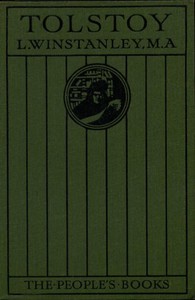
Tolstoy by Lilian Winstanley
Lilian Winstanley's Tolstoy isn't a standard biography. Written in the early 20th century, it's a passionate and thoughtful study that tries to connect the dots between the man and his work. Winstanley was a scholar with a deep interest in how a writer's life shapes their art, and she applies that lens to one of the most complex figures in literature.
The Story
There's no traditional plot here, but there is a compelling narrative. Winstanley traces Tolstoy's journey from his privileged, often reckless youth as a Russian nobleman, through his military service, and into his years as a world-famous author. She doesn't shy away from the messy parts: his intense spiritual searching that led him to reject his own earlier novels, his radical (and often difficult) political beliefs, and the painful tensions within his own family. The 'story' she tells is how all these personal battles—the quest for truth, the guilt over his privilege, the struggle between desire and morality—became the raw material for masterpieces like Anna Karenina and War and Peace. She shows us the human engine behind the literary machine.
Why You Should Read It
This book is for anyone who feels like classic authors are untouchable giants on a pedestal. Winstanley brings Tolstoy down to earth. Her writing has a clarity and warmth that makes a complex subject accessible. You get a real sense of Tolstoy's internal conflicts. One minute he's preaching simple, peasant-like Christianity, and the next he's living in a mansion struggling with family life. Winstanley doesn't judge him for these contradictions; she uses them to explain the incredible depth of his characters, who are also full of conflicting desires and ideals. Reading this feels like getting the key to a secret door in Tolstoy's novels. Suddenly, Levin's spiritual angst or Pierre's search for purpose makes so much more sense because you've seen where it came from.
Final Verdict
Perfect for book lovers who want to go deeper. If you've read and enjoyed Tolstoy's novels and want to understand the man behind them, this is a brilliant, engaging place to start. It's also great for readers interested in the creative process—how life gets transformed into art. Because it's an older study, it offers a unique historical perspective you won't find in modern biographies. Just be ready for a thoughtful, human portrait, not a sensational expose. It’s the kind of book that makes you want to immediately re-read Anna Karenina with brand new eyes.
This text is dedicated to the public domain. It serves as a testament to our shared literary heritage.
Paul Davis
1 year agoFrom a researcher's perspective, the data points used to support the main thesis are quite robust. If you want to master this topic, start right here.
Mary Perez
4 months agoThe layout of the digital version made it easy to start immediately, the argument presented in the middle section is particularly compelling. This should be on the reading list of every serious professional.
Kimberly Lee
4 months agoFrom a researcher's perspective, the structural organization allows for quick referencing of key points. An excellent example of how quality digital books should be formatted.
Ashley Thompson
9 months agoThe clarity of the introduction set high expectations, and the logic behind each conclusion is easy to follow and verify. A rare gem in a sea of mediocre content.
James Moore
8 months agoWhile browsing through various academic sources, the insights into future trends are particularly thought-provoking. This exceeded my expectations in almost every way.