1

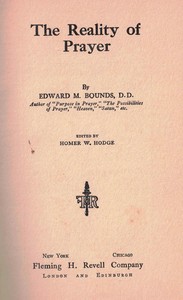
The reality of prayer — Reading Companion
7
1
Project Gutenberg
2024
Prayer -- Christianity; Jesus Christ -- Prayers
Readers of public-domain and historical texts
Project Gutenberg digital edition
en
Edition facts
Words: 40,163
Reading time: 175 min
Text sections: 19
Source:
Project Gutenberg record #73032
Edward M. Bounds examines prayer as a tangible, vital practice, using Christ's own prayers as models. The book emphasizes faith, persistence, and the transformative power of prayer in the believer's life, with a focus on scriptural examples and practical application.
Editorial Edition Score
4.8/5
★★★★★
★★★★★
Calculated from edition completeness, EPUB availability, text structure and catalogue metadata. Not a user rating.
Edition quality
Edward M. Bounds opens The Reality of Prayer by grounding prayer not in abstract theory but in the concrete actions and words of Jesus Christ. The editor, Homer W. Hodge, frames Bounds as a man who “walked and talked with the Lord,” setting an expectant tone for a work that treats prayer as a lived, urgent discipline. Bounds’s prose is direct and insistent, often repeating key phrases to drive home the necessity of persistent, faith-filled prayer. He draws repeatedly on Gospel scenes—Christ lifting his eyes at Lazarus’s tomb, blessing children, praying before Peter’s confession—to illustrate that prayer is both a privilege and a commanding spiritual weapon. The book’s structure moves from Christ’s example to the believer’s duty, with each chapter building a case for prayer as the central act of the Christian life.
Christ’s Praying as a Pattern
Bounds devotes substantial attention to the specific gestures and words of Jesus in prayer. He highlights the moment at Lazarus’s grave: “The lifting to Heaven of Christ’s eyes—how much was there in it!” For Bounds, this physical act carries spiritual weight—it “carried His whole being Heaven-ward” and engaged all of Heaven. He urges readers to cultivate a “Christly eye, Heaven lifted and Heaven arresting,” implying that prayer is not merely verbal but embodied and expectant. Similarly, the scene where Jesus blesses children becomes a lesson in humility and persistence: “The big ones must become little ones. The old ones must become young ones ere Christ will receive them.” Bounds insists that parents must bring infants to Christ through prayer, seeking blessing “before they know, themselves, anything about coming of their own accord.” These examples are not merely illustrative; they are prescriptive, forming a template for the reader’s own prayer life.
The Voice of Urgency and Repetition
Bounds’s rhetorical style is marked by urgency and repetition. He frequently uses short, emphatic sentences: “Prayer helps the little ones. The cradle must be invested with prayer.” Parallel structures reinforce his points: “Holy hands and holy praying have much to do with guarding and training young lives.” The word “must” appears often, conveying a sense of non-negotiable duty. Bounds also employs direct address and exclamations, as in “O for a people with the Christly eye!” This creates a hortatory, almost sermonic tone that seeks to move the reader to action. The editor’s foreword notes that Bounds “lived ever on prayer ground,” and the prose itself reflects that intensity—it is the language of a man who sees prayer as the “great weapon in his arsenal.” Readers should expect a text that exhorts as much as it explains, with a rhythm that mirrors the persistence it advocates.
Theological Anchors and Practical Application
While Bounds grounds his arguments in Scripture, he consistently draws practical conclusions. The confession of Peter, which occurs “as he was alone praying,” is presented not as a theological abstraction but as a model for how prayer precedes and enables spiritual insight. Bounds writes that “flesh and blood hath not revealed it unto thee, but my Father which is in heaven,” linking revelation directly to the prayer context. Similarly, the incident with the children leads to a directive: “With untiring importunity are they to be brought to Christ in earnest, persevering prayer by their fathers and mothers.” The book thus moves fluidly between exegesis and application, treating biblical episodes as immediate resources for the reader’s own practice. Bounds does not linger on doctrinal disputes; his focus remains on the reality of prayer as a transformative encounter with God, accessible to every believer.
The Reality of Prayer rewards a slow, reflective reading. Bounds’s arguments are cumulative, and his frequent scriptural references invite cross-checking with the Gospel accounts. Readers may find it helpful to read a chapter, then pause to consider how the specific prayer principles apply to their own habits. The book’s brevity—nineteen sections over roughly 175 minutes of reading—belies its density; each paragraph is packed with exhortation and insight. Approach it as a manual for spiritual discipline rather than a theological treatise, and let Bounds’s urgent voice challenge your assumptions about what prayer can be.
Reader reflection
What did you think of this book?
Answer a few questions and save a private reflection on this device.
Your progress
0
/
10
2
Did this book hold your interest?
3
How likely are you to recommend this book?
4
How easy was the book to follow?
5
How strong was your personal connection to the text?
6
How clearly were the main ideas presented?
7
How useful did the reading feel?
8
Did the story or argument move comfortably?
9
Which lesson or insight stayed with you?
10