1

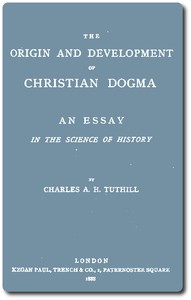
The Origin and Development of Christian Dogma: An essay in the science of history — Reading Notes
3
1
Project Gutenberg
2017
Christianity -- Origin
Readers of public-domain and historical texts
Project Gutenberg digital edition
en
Edition facts
Words: 40,822
Reading time: 178 min
Text sections: 5
Source:
Project Gutenberg record #56279
An 1888 essay tracing Christian dogma's origin to the collision of Jewish monotheism and pagan polytheism, arguing that doctrinal inconsistencies arise from this fusion. Tuthill applies historical inquiry to separate Jewish and pagan contributions, focusing on the Atonement and Incarnation as key examples.
Editorial Edition Score
4.7/5
★★★★★
★★★★★
Calculated from edition completeness, EPUB availability, text structure and catalogue metadata. Not a user rating.
Edition quality
Charles A. H. Tuthill opens his 1888 essay by contrasting Christianity with other dogmatic religions, pointing to the Athanasian Creed as evidence of fundamental inconsistencies within Christian doctrine. He argues that these inconsistencies stem not from the natural evolution of dogma but from the collision of two opposing streams: Jewish monotheism and pagan polytheism. This combination, he claims, gives Christianity its unique power to satisfy both higher and lower religious instincts, while also producing its complex theology. Tuthill’s method is explicitly historical: he aims to trace the causes of separate dogmas through the history of Judaism and the grafting of pagan ideas onto a Jewish stock.
A Thesis of Collision
Tuthill’s central argument is that Christian doctrine is the product of a collision between monotheistic Judaism and polytheistic paganism. He asserts that this collision explains the inconsistencies pervading Christianity, such as the Trinity, which combines monotheistic and polytheistic elements. The author distinguishes Christianity from Islam and Judaism, which he sees as internally consistent, and attributes Christianity’s doctrinal complexity to its hybrid origins. This thesis is stated clearly in the introduction and serves as the framework for the entire essay. Tuthill does not claim that all dogmas are equally mixed; rather, he proposes a canon of historical criticism: Jewish-origin dogmas belong to the earliest period, while pagan-origin dogmas appear later, after Gentile conversion began. The Atonement is presented as the chief Jewish dogma, the Incarnation as the chief pagan one.
The Atonement as the First Dogma
Tuthill traces the origin of the Atonement to Christ himself, arguing that the Last Supper was a symbolic sacrament instituting a new Passover. He writes that Christ “probably distributed bread and wine as his body and blood,” making the Atonement the first distinctive Christian dogma. The author acknowledges uncertainty but claims probability is strong, citing the need for an “indispensable link in a great chain of development.” He then describes how the early Jewish-Christian community gradually grasped this dogma through repeated celebration of the Eucharist. The ceremony “brought the Christians together and marked them off from the Jews around them,” and over time the sacrificial meaning of Christ’s death became clear. Tuthill emphasizes that as Jews, the first disciples readily accepted the Atonement, which explained their position as followers of a crucified Messiah.
Narrative Pace and Methodological Shifts
The essay’s pace changes markedly between the introduction and later chapters. The introduction is brisk and assertive, laying out the collision thesis in broad strokes. By Chapter IV, the tone becomes more cautious and speculative, as Tuthill acknowledges gaps in evidence. For instance, he admits “there is no certainty in this conclusion” regarding the Last Supper, and relies on probability and the logic of development. This shift reflects his method: he moves from a confident overview to detailed reconstruction of early Christian belief, where sources are sparse. The author also uses a “fair canon of historical criticism” to assign dogmas to periods, a tool that allows him to navigate the lack of direct evidence. Readers should note how Tuthill balances bold claims with careful hedging, especially when discussing the transition from Jewish to pagan influences.
Tuthill’s essay is best approached as a sustained argument rather than a neutral history. Readers should track how he applies his collision thesis to each dogma, noting where he relies on probability versus direct evidence. The author’s method—tracing ideas through Judaism and then through pagan grafting—shapes every chapter. Pay attention to his use of the word “probably” and his explicit admission of uncertainty, which reveal the limits of his sources. This is a work of speculative historical theology, not a definitive account, and its value lies in the clarity of its central thesis and the rigor of its application.
Reader reflection
Your personal reading reflection
Build a private reading journal entry for this title.
Your progress
0
/
10
2
What was your overall reaction to the book?
3
Would you recommend this book to another reader?
4
Did the language feel accessible?
5
Did any part of the book stay with you emotionally?
6
Did the book give you something worth debating?
7
Could you see yourself revisiting this book?
8
Could you follow the author’s main argument?
9
Which lesson or insight stayed with you?
10