1

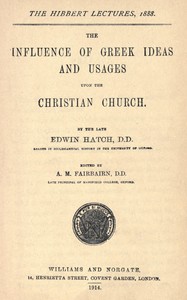
The influence of Greek ideas and usages upon the Christian church — Key Ideas to Explore
6
1
Project Gutenberg
2023
Church history -- Primitive and early church, ca. 30-600; Philosophy, Ancient; Theology, Doctrinal; Philosophy -- History
Readers of public-domain and historical texts
Project Gutenberg digital edition
en
Edition facts
Words: 108,419
Reading time: 472 min
Text sections: 27
Source:
Project Gutenberg record #72255
Edwin Hatch's posthumous Hibbert Lectures examine how Greek philosophical and ethical concepts shaped early Christian doctrine and practice, using Stoic and Platonic texts alongside patristic sources. The unfinished manuscript, edited by A. M. Fairbairn, offers a scholarly reconstruction of intellectual exchanges between Hellenistic culture and primitive Christianity.
Editorial Edition Score
4.9/5
★★★★★
★★★★★
Calculated from edition completeness, EPUB availability, text structure and catalogue metadata. Not a user rating.
Edition quality
Edwin Hatch's Hibbert Lectures of 1888, published posthumously in an edition prepared by A. M. Fairbairn, trace the infiltration of Greek philosophical categories into early Christian thought. The surviving manuscript—eight lectures fully drafted, four more reconstructed from notebooks—reveals a scholar working at the intersection of classical philology and ecclesiastical history. Hatch juxtaposes Stoic ethics with Semitic legal metaphors, arguing that concepts like 'wages for work done' and 'positive law' entered Christian moral vocabulary from Jewish rather than Greek sources. The editorial apparatus, including a preface detailing the reconstruction process, makes visible the fragmentary nature of the evidence.
Stoic Theodicy and Christian Adaptation
Hatch devotes sustained attention to Stoicism, particularly Epictetus, as a parallel to Christian moral teaching. He quotes Epictetus's exhortation to 'sing hymns to God' for the gift of rational understanding, noting the Stoic emphasis on aligning human will with nature's movement. The contrast with primitive Christianity is drawn sharply: where Stoics see a rational cosmos governed by immanent law, early Christians picture an Eastern sheyk who pays wages for labor. Hatch does not claim direct borrowing but highlights structural affinities—both systems demand acquiescence to divine will, yet the Stoic version frames this as active cooperation, not passive submission. The excerpts show Hatch using extended quotations from Epictetus (in Greek and translation) to build his case, a method that lets the ancient texts speak before he offers commentary.
The Manuscript's Unfinished Architecture
The editorial preface by Fairbairn candidly describes the state of Hatch's papers: 'a series of note-books, which seemed at first sight but an amorphous mass or collection of hurried and disconnected jottings, now in ink, now in pencil.' The first eight lectures had been sent to press, with six corrected proofs; the remaining four existed only as delivered oral lectures, with 'selected passages' and oral connections lost. Fairbairn, assisted by Bartlet and Sanday, reconstructed these from cross-references and symbols. This editorial labor means the reader encounters a layered text: Hatch's finished prose, his rough notes, and the editors' bridging passages. The resulting work is as much a record of scholarly reconstruction as it is an argument about Greek influence.
Semitic and Greek Moral Frameworks Compared
Hatch identifies two competing moral metaphors in early Christianity: the Semitic model of wages and law, and the Greek model of rational self-discipline. He roots the wage metaphor in the social reality of the fellahin, for whom 'the day's work brought the day's wages.' This concrete economic imagery, he argues, shaped Christian ideas of reward and judgment. In contrast, Greek ethics, exemplified by Stoicism, emphasizes inner harmony with nature. Hatch does not resolve the tension but presents both as active forces in the formation of Christian doctrine. The excerpts break off before he can fully develop the synthesis, leaving the reader with a provocative juxtaposition rather than a closed argument.
Readers should approach this edition as a scholarly artifact: Hatch's incomplete argument is framed by the editors' careful reconstruction. The footnotes and cross-references reward attention, as they reveal the underlying notebook structure. Those interested in the mechanics of intellectual history will find the preface as illuminating as the lectures themselves, documenting how a posthumous work is assembled from fragments.
Reader reflection
How will you remember this book?
Save your reaction, strongest insight, and memorable passage.
Your progress
0
/
10
2
What was your overall reaction to the book?
3
Is this a title you would suggest to others?
4
How much effort did this book require?
5
What did you think about the pace?
6
Would you like to discuss this book with someone?
7
Could you see yourself revisiting this book?
8
Was the book easy to understand?
9
What changed or sharpened your thinking?
10