1

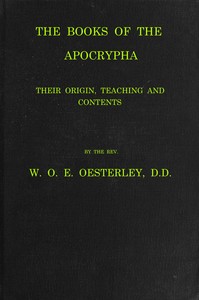
The books of the Apocrypha — Edition Insights
7
2
Project Gutenberg
2025
Bible. Apocrypha -- Introductions
Readers of public-domain and historical texts
Project Gutenberg digital edition
en
Edition facts
Words: 179,105
Reading time: 779 min
Text sections: 48
Source:
Project Gutenberg record #75434
W. O. E. Oesterley examines the Apocrypha's origins, teachings, and contents, focusing on authorial choices in diction, dialogue, and description. The analysis traces angelology across Tobit, Judith, Daniel additions, and Maccabees, noting how each book uses distinct narrative strategies to depict divine intervention.
Editorial Edition Score
4.9/5
★★★★★
★★★★★
Calculated from edition completeness, EPUB availability, text structure and catalogue metadata. Not a user rating.
Edition quality
W. O. E. Oesterley’s study of the Apocrypha proceeds book by book, attending closely to the language and narrative techniques that distinguish these texts. Rather than offering a general survey, he isolates how each author deploys specific diction, dialogue, and descriptive details to shape theological meaning. For instance, in his treatment of angelic appearances, Oesterley contrasts the guardian angel in Tobit—who speaks directly and identifies himself as “one of the seven holy angels”—with the more spectacular, almost cinematic apparitions in 2 Maccabees, where a horse with a terrible rider strikes Heliodorus. These differences, Oesterley suggests, reflect not only diverse sources but also distinct authorial intentions regarding the nature of divine intervention.
Angelic Diction and Narrative Function
Oesterley’s method is evident in his handling of angelology. He notes that in Tobit, the angel Raphael speaks in the first person, declaring, “I am Raphael, one of the seven holy angels.” This direct self-identification is a deliberate authorial choice, lending authority and intimacy to the narrative. By contrast, in the Additions to Daniel, angels are described through action rather than speech: the angel of the Lord “came down into the furnace” and “made the midst of the furnace as it had been a moist whistling wind.” Oesterley highlights how the descriptive language here—the paradoxical “moist whistling wind”—creates a sensory contrast that underscores the miraculous nature of the event. In 2 Maccabees, the angelic rider is depicted with “magnificent trappings” and a “golden panoply,” a choice that emphasizes visual splendor and martial power. Oesterley’s analysis shows that each author selects a different register of diction—conversational, sensory, or epic—to convey the angel’s role.
Dialogue as a Window into Character
Oesterley pays particular attention to how dialogue reveals character and theological stance. In the Book of Tobit, Raphael’s speech is not merely informative but also relational: he presents the prayers of the saints and goes “in before the glory of the Holy One.” This phrasing, Oesterley observes, positions the angel as an intercessor, a role reinforced by the narrative framing. In contrast, the dialogue in Susanna is sparse and functional: the angel of the Lord is said to bestow “a spirit of discernment” upon Daniel, but no words are exchanged. Oesterley notes that the author of Susanna uses indirect description rather than direct speech, perhaps to maintain focus on Daniel’s human wisdom. In the Prayer of Manasses, the angelic host is invoked in a doxological formula: “For all the host of heaven doth sing Thy praise.” Here, dialogue gives way to liturgical praise, a shift that Oesterley links to the prayer’s genre as a penitential psalm. These choices, he argues, are not accidental but reflect each author’s purpose—whether to instruct, to dramatize, or to inspire devotion.
Descriptive Strategies for Divine Intervention
Oesterley’s analysis of descriptive passages reveals a spectrum of authorial approaches to depicting the supernatural. In 2 Maccabees, the description of Heliodorus’s encounter is vivid and detailed: a horse “rushing fiercely forward” strikes with its forefeet, while two youths “scourged him unceasingly.” The accumulation of physical details—the horse’s trappings, the youths’ strength and beauty—creates a scene of overwhelming power. Oesterley notes that this descriptive strategy emphasizes the tangible, almost violent, nature of divine intervention. In contrast, the Book of Judith contains no angelic appearances at all; Oesterley points out this absence as a deliberate authorial choice, perhaps to highlight human agency and faith. In Bel and the Dragon, the angel’s transport of Habakkuk is described with minimal detail: “the angel of the Lord took up the prophet Habakkuk by the hair.” Oesterley observes that the brevity of this description, combined with the extraordinary action, creates a sense of abrupt miracle. These varying descriptive strategies, he suggests, reflect different theological emphases: the Maccabean author stresses God’s power, while the author of Bel and the Dragon focuses on providential care.
Structural Patterns and Recurring Motifs
Oesterley’s close reading also uncovers structural patterns across the Apocrypha. He notes that references to angels often appear at key narrative junctures: in Tobit, Raphael’s self-identification occurs at the climax of the story; in 2 Maccabees, the angelic rider appears at moments of crisis, such as the attempt on the temple. Oesterley observes that the author of 2 Maccabees uses a threefold pattern of angelic intervention (iii.24 ff., xi.6-10, xv.11-16), each time with increasing detail and dramatic effect. In the Additions to Esther, the comparison of the king to an angel of God is a single, isolated simile, which Oesterley sees as a minor but telling motif that elevates the monarch’s status. The Epistle of Jeremy mentions a guardian angel in passing, as a comfort to the captives. Oesterley’s attention to these structural placements reveals how each author integrates angelic references into the broader narrative architecture, using them to reinforce themes of deliverance, judgment, or divine presence.
Oesterley’s study rewards readers who attend to the specific words and narrative choices of each Apocryphal book. By comparing how different authors handle similar subjects—such as angelic visitations—he illuminates the literary and theological diversity within this collection. Readers will find it useful to read the biblical texts alongside Oesterley’s commentary, noting where his observations about diction and description open new angles on familiar stories. His work is a model of careful, evidence-based analysis that respects the distinct voice of each ancient writer.
Reader reflection
How did this book work for you?
Your answers remain private and are stored only in this browser.
Your progress
0
/
10
2
Did this book hold your interest?
3
Would you pass this book on to a friend?
4
How easy was the book to follow?
5
Did you relate to its people, ideas, or situations?
6
Did any part of the book stay with you emotionally?
7
How did the reading compare with what you expected?
8
How understandable was the text?
9
What changed or sharpened your thinking?
10