1

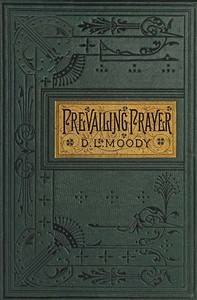
Prevailing Prayer: What Hinders It? — A Reader’s Guide
3
1
Project Gutenberg
2020
Christian life; Prayer -- Christianity
Readers of public-domain and historical texts
Project Gutenberg digital edition
en
Edition facts
Words: 41,062
Reading time: 179 min
Text sections: 26
Source:
Project Gutenberg record #61883
Dwight L. Moody's 1884 work examines obstacles to effective prayer through biblical examples and personal anecdotes, emphasizing fervency, faith, and the heart's posture over ritual.
Editorial Edition Score
4.8/5
★★★★★
★★★★★
Calculated from edition completeness, EPUB availability, text structure and catalogue metadata. Not a user rating.
Edition quality
Dwight L. Moody opens Prevailing Prayer: What Hinders It? with a prefatory note that frames prayer and Scripture as the two essential means of grace, warning against imbalance: reading without prayer leads to pride, while praying without Scripture breeds fanaticism. This practical concern for proportion sets the tone for a book that is less a theological treatise and more a series of exhortations grounded in biblical narrative and personal testimony. Moody’s voice is direct and homiletic, often punctuated by quoted authorities—Bishop Hall, Archbishop Leighton, and Brooks—whose vivid metaphors (cold prayers as arrows without heads) he deploys to drive home the necessity of fervency.
The Rhetoric of Earnestness
Moody’s prose is studded with borrowed imagery that he uses to press his central claim: prayer must be fervent to prevail. He quotes Bishop Hall’s comparison of prayer to an arrow: drawn up but a little way, it falls short; pulled to the head, it flies swift and pierces deep. Leighton’s distinction between “gilded paper” and “heart-sense” reinforces the idea that God regards the inward motion, not the outward form. Brooks’s catalogue—cold prayers are “as arrows without heads, as swords without edges, as birds without wings”—accumulates to a crescendo that Moody clearly expects to stir his hearers. These borrowed passages are not mere decoration; they function as proof-texts for a practical theology of intensity.
The Syrophenician Woman as Model
Moody retells the story of the Syrophenician woman (Mark 7:24–30) to illustrate persistent, self-identifying prayer. He notes that she “put herself in the place of her child,” crying “Lord, help me!” rather than merely pleading for her daughter. This detail—her shift from intercession to personal identification—becomes for Moody the key to prevailing prayer. He contrasts the disciples’ desire to send her away with Christ’s eventual response, arguing that such earnestness cannot be turned aside. The anecdote is typical of Moody’s method: he selects a single narrative moment, isolates its emotional and theological pivot, and applies it directly to the reader’s practice.
Anecdotal Evidence from the Revival Meeting
Moody draws on his own ministry experience, recalling a meeting where he invited those who wished to be prayed for to come forward. A woman who was already a Christian knelt among the seekers; Moody’s memory of “the look on her face” conveys his conviction that prayer must arise from genuine need, not mere habit. This brief vignette—only a few lines in the excerpt—serves as a concrete example of the confusion between ritual and real desire. Moody does not elaborate on her story; he lets the image stand as a caution against assuming that outward compliance equals inward urgency. The anecdote grounds his abstract principles in a recognizable, if understated, human moment.
The Structure of Hindrances
The table of contents reveals a deliberate progression: after chapters on adoration, confession, restitution, and thanksgiving, Moody turns to forgiveness, unity, faith, petition, and submission. This sequence moves from the worshiper’s posture toward God to relational and communal obstacles, then to the interior disposition of faith. The chapter “Answered Prayers” closes the list, suggesting that Moody’s aim is not merely to diagnose hindrances but to lead readers toward the experience of answered prayer. Each chapter title functions as a step in a practical curriculum, and the book’s structure itself embodies the idea that prayer is a discipline to be learned, not a gift passively received.
Readers approaching Prevailing Prayer should expect a series of addresses designed for oral delivery—direct, repetitive, and punctuated by illustrative stories. Moody’s reliance on quoted authorities and biblical exemplars means the book rewards attention to his selection and arrangement of sources. The excerpts suggest that his primary concern is not doctrinal novelty but the cultivation of a specific emotional and spiritual intensity. Those who read with an eye to Moody’s rhetorical strategies—his use of metaphor, anecdote, and structural progression—will find a work that is as much about the art of persuasion as about the practice of prayer.
Reader reflection
Your personal reading reflection
Build a private reading journal entry for this title.
Your progress
0
/
10
2
How did the book work for you overall?
3
Would you encourage someone else to read it?
4
What was the reading difficulty like?
5
What did you appreciate most?
6
How personally connected did you feel to the book?
7
How did the pace of the book feel?
8
How useful were the ideas in this book?
9
In one sentence, what did you learn?
10