1

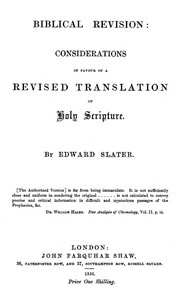
Biblical Revision considerations in favour of a revised translation of Holy Scripture — A Reader’s Guide
3
0
Project Gutenberg
2021
Bible -- Translating; Bible -- Versions
Readers of public-domain and historical texts
Project Gutenberg digital edition
en
Edition facts
Words: 16,766
Reading time: 73 min
Text sections: 2
Source:
Project Gutenberg record #64728
Edward Slater's 1856 pamphlet argues for a revised English Bible translation, citing the Authorized Version's inaccuracies and advocating accessibility. The text balances reverence with reform, addressing objections from tradition while promoting scholarly emendations for lay readers.
Editorial Edition Score
4.5/5
★★★★★
★★★★★
Calculated from edition completeness, EPUB availability, text structure and catalogue metadata. Not a user rating.
Edition quality
Edward Slater's 1856 pamphlet opens by framing the call for a revised Bible translation as a sign of the times, a desire for improvement that extends beyond material goods. He immediately acknowledges the delicacy of the subject, noting that prejudice often masquerades as religious sanction. The epigraph from Dr. William Hales sets the tone: the Authorized Version is 'far from being immaculate' and fails to convey precise meaning in difficult passages. Slater does not dismiss the emotional attachment to familiar phrasing—he quotes Dr. Knox's fear that a modernized Bible would lose its 'air of sanctity'—but counters that the same objection would have prevented the Authorized Version itself. The pamphlet thus positions itself as a measured, evidence-based argument for revision, not a wholesale rejection of tradition.
The Temper of the Times and the Weight of Prejudice
Slater identifies a 'desire, now extensively evinced, for an improved translation' as a characteristic of an age 'replete with new and unlooked-for events.' He notes that earlier solitary voices for revision died away, stifled by 'Prejudice or Fear.' The pamphlet’s cautious tone reflects an awareness that the subject is 'entrenched in prejudices under the seeming sanction of religion itself.' Slater quotes Dr. Knox at length: the Bible’s familiar phrasing is learned in infancy, and change would startle congregations. Yet Slater argues that the same objection would have prevented the Authorized Version from replacing earlier translations. He does not dismiss the emotional bond but insists it is not sufficient to overrule the plea for accuracy.
Accessibility and the Esoteric-Exoteric Divide
A central concern is the unequal distribution of biblical knowledge. Slater laments that 'the mass of reading now required to peruse Scripture with due edification and interest is altogether beyond the leisure of the busy, or the means of the less affluent.' He warns that the church is 'drifting away from its fundamental basis of universality,' creating an esoteric class with erudition and an exoteric class left with 'a sorry heap of prejudices.' A revised translation, he argues, would 'garner up' the 'beautiful emendations' scattered across commentaries—citing Archbishop Whately and Professor Scholefield—and make them available to all. The goal is to 'relieve the unlettered from dependence on the Commentary' so that 'they who run might read.'
Unity Through Clearer Translation
Slater contends that a revised translation could reduce 'unchristian differences' fostered by difficulties inherent in the Bible 'as a translation rather than as an original.' He uses the metaphor of a musical instrument: 'By repairing the instrument, we may find a great impediment to our common understanding and accord removed.' The resulting unity would be 'real, not simulated—uniform, not patched up for the occasion.' He acknowledges that 'divers forms of worship, and many varying shades of opinion, may co-exist with this unity,' citing charity that 'thinketh no evil.' The pamphlet thus presents revision not as a threat to diversity but as a means to a more authentic, sympathetic bond of belief.
Slater’s pamphlet is a specimen of mid-19th-century Anglican reformist thought, arguing from practicality rather than doctrinal upheaval. Readers should note how he weaves quotations from authorities like Dr. Hales and Dr. Knox to frame his case, and how the recurring concern for lay accessibility anticipates later debates about biblical literacy. The text is short—under 17,000 words—and its argument unfolds through repeated contrasts between tradition and improvement, esoteric and exoteric, instrument and impediment. Approach it as a historical document of translation theory and religious communication.
Reader reflection
How will you remember this book?
Save your reaction, strongest insight, and memorable passage.
Your progress
0
/
10
2
What was your overall reaction to the book?
3
Is this a title you would suggest to others?
4
How demanding did the text feel?
5
Which part made the strongest impression?
6
How closely did the book connect with your experience?
7
Did you gain anything practical from the text?
8
Was the book easy to understand?
9
What is the main idea you are taking away?
10