1

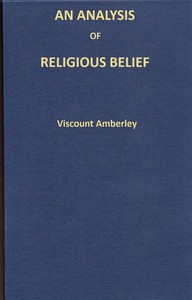
An analysis of religious belief — Story, Setting & Ideas
8
2
Project Gutenberg
2021
Religions
Readers of public-domain and historical texts
Project Gutenberg digital edition
en
Edition facts
Words: 292,852
Reading time: 1274 min
Text sections: 47
Source:
Project Gutenberg record #64748
Viscount Amberley's 1877 work examines sacred texts across cultures, arguing that their defining feature is formlessness—a lack of artistic structure—and comparing them to national epics like the Volsunga-Saga and Homeric poems.
Editorial Edition Score
4.9/5
★★★★★
★★★★★
Calculated from edition completeness, EPUB availability, text structure and catalogue metadata. Not a user rating.
Edition quality
Viscount Amberley opens his 1877 An Analysis of Religious Belief by distinguishing sacred books from national epics through a single, striking trait: formlessness. He describes sacred texts as “without form,” lacking the “artistic finish” and “well-defined edifice” of works like the Iliad or the Volsunga-Saga. This observation, drawn from the excerpts, sets the stage for a comparative study that spans the Mahâbhârata, the Eddas, and the legends of King Arthur. Amberley’s method is analytical rather than devotional, treating religious writings as human productions subject to the same critical scrutiny as any other literature.
Formlessness as a Defining Trait
Amberley argues that sacred books differ from other ancient works by their lack of structural order. He writes that they “read not unfrequently as if they had been carelessly jotted down without the smallest regard to order,” and that one “might open them anywhere and close them anywhere without material difference.” This formlessness, he claims, sets them apart even from anonymous national epics, which possess “grace, finish, perfection of style.” The term is deliberately awkward, but Amberley insists it captures a peculiar feature: sacred texts often have “neither beginning, middle, nor end.” This is not a dismissal but a classification, one that invites readers to consider how the absence of conventional structure might serve religious purposes.
Comparing Sacred and Epic Narratives
Amberley contrasts sacred books with epics like the Homeric poems and the Volsunga-Saga. While the latter are also anonymous, they exhibit “construction, combination of parts into a well-defined edifice.” The Volsunga-Saga, despite its rude form, tells a tale of “exquisite pathos” and “deep and tragic interest,” treating its characters as human and drawing no moral. Sacred stories, by contrast, are always “subservient to an ulterior purpose”—in the Old and New Testaments, to enforce theological doctrines. This distinction, grounded in the excerpts, suggests that Amberley values narrative art for its own sake, and sees religious texts as fundamentally instrumental.
The Role of Mythological Incidents
Amberley acknowledges that mythological elements appear in both sacred and epic works. He notes that the “mythological incidents of the Iliad and the Odyssey are grotesque,” requiring the poet’s genius to make them tolerable. Similarly, the Volsunga-Saga’s mythological foundation throws “a grotesqueness” over its incidents. Yet in sacred books, such incidents serve doctrine rather than human drama. This observation, drawn from the excerpts, reveals Amberley’s interest in how the same raw material—myth—can be shaped to different ends. Readers may note that his analysis avoids theological judgment, focusing instead on literary and structural criteria.
A Reader’s Approach to the Text
Given the work’s length (over 290,000 words) and its 47 sections, a first-time reader may benefit from Amberley’s own method: treat each section as a self-contained argument. The excerpts show that he moves from general principles to specific examples, often comparing traditions side by side. Pay attention to his recurring distinction between formless sacred books and artistically constructed epics, as it provides a thread through the analysis. The American publisher’s preface notes the “boldness of language” and the “freedom” with which Amberley examines creeds, so expect direct statements rather than apologetic hedging.
Amberley’s An Analysis of Religious Belief is best read as a work of comparative criticism rather than theology. Its value lies in the specificity of its observations—the formlessness of sacred texts, the instrumental use of narrative, the contrast with national epics—rather than in any overarching conclusion. Readers interested in the history of religious studies will find here a late-Victorian attempt to apply literary analysis to scripture, one that anticipates later secular approaches without fully abandoning the era’s cultural assumptions.
Reader reflection
How did this book work for you?
Your answers remain private and are stored only in this browser.
Your progress
0
/
10
2
How did the book work for you overall?
3
How likely are you to recommend this book?
4
What was the reading difficulty like?
5
What was the strongest part of the book?
6
How strongly did the book affect you emotionally?
7
Did the story or argument move comfortably?
8
Would this book work well in a reading group?
9
What is the main idea you are taking away?
10